
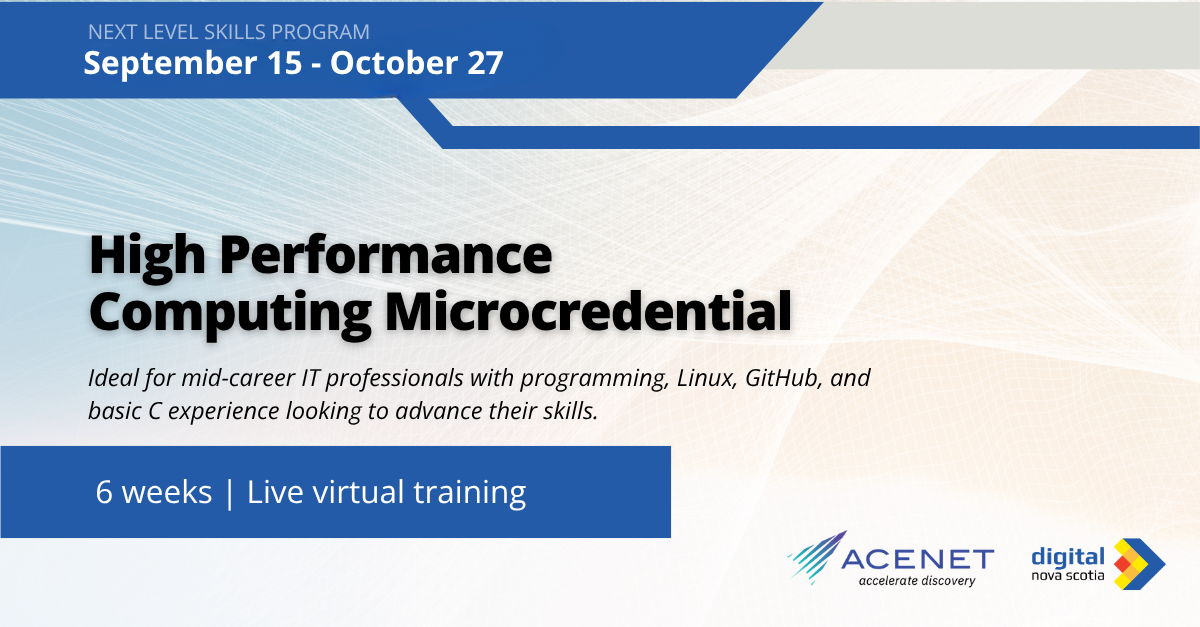
September 15 – October 27, 2026
6-week program, 2 X 2-hour sessions/week | 24 hours total training
Valued at $1,225.00 + HST
Eligible DNS members pay $310 + HST
Hosted by acenet
This course combines virtual classroom teaching and an independent study project. Participants will learn the fundamentals of high-performance computing and apply those skills on ACENET’s computing cluster.
High-Performance Computing (HPC) refers to the use of supercomputers with thousands of processing units to solve tasks that are too large and/or complex for a personal laptop or desktop. Breaking a large problem into tens, hundreds, or even thousands of smaller problems to be solved in parallel reduces processing time to a fraction of what it would be on a desktop or workstation.
HPC is widely used to scale up code and optimize performance in large data mining, training of AI models, engineering and scientific simulations, remote sensing, land and ocean mapping, and many other fields.
What will you learn? (More information in the FAQ section)
-
- How to securely access and work within high-performance computing (HPC) environments.
- How to run and manage large-scale computing workloads using batch scheduling tools.
- How to profile and optimize code performance for faster, more efficient computation.
- How to build parallel programs with OpenMP and CUDA.
- How to deploy and manage HPC clusters on cloud platforms.
- How to leverage ACENET’s supercomputing infrastructure and connect with Atlantic Canada’s tech ecosystem.
Who’s right for this course?
This intermediate level course is designed for mid-career IT professionals. This course will target individuals with the following prerequisites:
- Proficiency with programming and IT development
- Proficiency with Linux
- Familiarity with Github (asynchronous learning material will provided prior to course commencement)
- Basic familiarity with the C programming language (either a single university-level course, or self-taught are sufficient).